Design Note
The Character Sheet Is Where the Investment Begins
I can still remember the first game that truly got inside my head. It was not on a screen. It was a Saturday Dungeons & Dragons campaign at a public library in Vancouver when
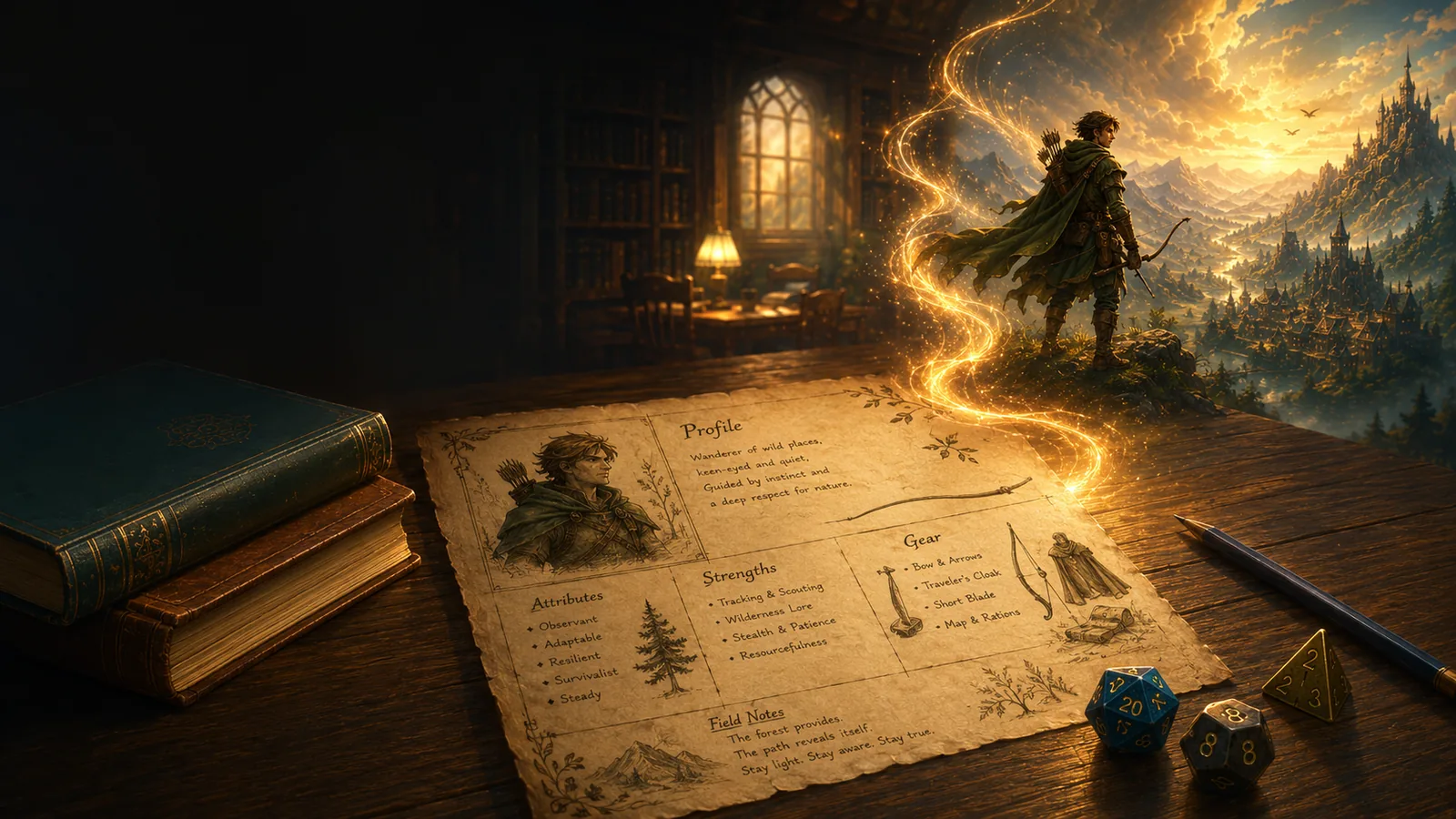
I can still remember the first game that truly got inside my head.
It was not on a screen.
It was a Saturday Dungeons & Dragons campaign at a public library in Vancouver when I was eight years old. There was a Dungeon Master, a table, dice, books, imagination, and the simple act of creating a character.
That was the hook.
You named the character. You chose who they were. You imagined what they might become. Then the DM placed you in a world, often in a tavern or some dangerous place just beyond safety, and suddenly you were not just listening to a story. You were making decisions inside one.
As a player, you could become a hero.
As a Dungeon Master, you could create worlds.
That idea stayed with me.
My family did not have a lot of money, and new rulebooks were not easy to get. I remember trading things I had for Dungeons & Dragons books and campaign material. Before long, I was running games for other kids. I became the DM. I was not just playing a character anymore. I was creating situations, choices, dangers, rewards, and consequences for other people to move through.
That is probably where the idea behind Character Sheet Studios really begins.
Not because every game should literally be Dungeons & Dragons. Not because every game needs a paper character sheet. But because almost every game I have ever loved begins with some version of that same investment.
Who are you?
What can you do?
What are you willing to risk?
What happens because of the choices you make?
A character sheet is more than stats. It is a promise. It tells the player: this person matters because you are going to make decisions for them.
That is true in tabletop RPGs, but it is also true in strategy games, tactical games, role-playing games, squad games, survival games, deckbuilders, and anything where the player starts to care about a build, a party, a crew, a pilot, a soldier, a ship, or a world.
The sheet may be visible or invisible. It may be a literal page, a skill tree, a deck, a ship layout, a roster, a loadout, or a set of scars the game remembers. But the feeling is the same.
You invest.
You choose.
You change.
You become.
After Dungeons & Dragons came Warhammer Fantasy, Warhammer 40,000, and early networked PC games. One of the kids I grew up playing campaigns and games with eventually became connected to the small company that became Blizzard. Through that circle, I was lucky enough to be around some early Blizzard-era games and players when PC gaming still felt like it was being invented in real time.
My game background includes an early Warcraft beta tester credit. I played early builds of Warcraft and other Blizzard games, and later spent countless hours in games like Diablo and StarCraft. Across my life, I have spent countless hours playing, studying, and comparing games across tabletop, PC, and console, not just as entertainment, but as systems for choice, pressure, risk, and consequence.
But the point is not the number.
The point is what those games taught me.
Games are at their best when they give players enough structure to understand the world, and enough freedom to feel like their decisions matter. I do not think the goal is to create loopholes for players to exploit. A good game should avoid harmful loopholes where it can. But players will always test the boundaries of a system. They will try strange plans. They will optimize. They will take risks. They will look for freedom inside the rules.
That is not a problem to solve away completely. That is part of why games are alive.
Diablo was one of the places I saw that clearly. The game was built around action, loot, danger, and replay. After people had played through it again and again, players started creating their own reasons to keep going. They dueled. They chased items. They tested what the game allowed. Sometimes that revealed exciting social play. Sometimes it revealed behavior the design probably had not fully intended.
That experience shaped how I think about game systems.
A good game should not feel like the player is trapped on tracks. It should not be so loose that nothing matters either. The sweet spot is somewhere harder to reach: clear rules, real pressure, meaningful choice, a little luck, and consequences that make the player feel responsible for what happened.
Your thought process should matter.
Your decisions should matter.
For good or bad, the game should remember enough that the story feels like it came from what you did.
That belief followed me into software product management. In product work, you learn quickly that the system you design and the system people actually use are not always the same. People skip steps. They misunderstand labels. They invent workarounds. They show you where the design is unclear. Sometimes they reveal a bug. Sometimes they reveal the better version of the product.
Games are different because the player’s freedom is part of the promise. The goal is not just efficiency. The goal is investment.
That is what Character Sheet Studios is about.
Our first project, Project Infinite Horizons, is a science fiction roguelike deckbuilder about a stranded ship trying to find a way home. On the surface, that means route choices, cards, encounters, scarce resources, crew assignments, repairs, upgrades, and combat.
Underneath, it is about the same thing that hooked me in third grade.
You create identity through choices.
Do you spend the torpedo now, or save it for something worse?
Do you protect the hull, or push for the objective?
Do you assign your best crew member to the safest task, or ask someone damaged to carry the moment?
Do you take the reward that helps this run, or the choice that changes what future runs become?
Those are systems questions, but they are also character questions.
I do not think the best games are the ones where every choice is clean. I think the best games are the ones where the player understands enough to make a plan, but the world pushes back hard enough that the plan becomes a story.
That is the thread running from a public library Dungeons & Dragons table in Vancouver to Warhammer armies, early networked PC games, Blizzard-era strategy and action RPGs, thousands of hours across PC and console games, and the product work I have done professionally.
It is also the thread behind Character Sheet Studios.
We are building games about choices that leave marks. Games where systems are readable enough to plan around, but alive enough to surprise you. Games where a build is not just a build, a crew is not just a stat block, and a run is not just a score.
Because the investment starts before the first battle.
It starts when you look at who you are, imagine who you could become, and make the first choice.
Related Studio Updates
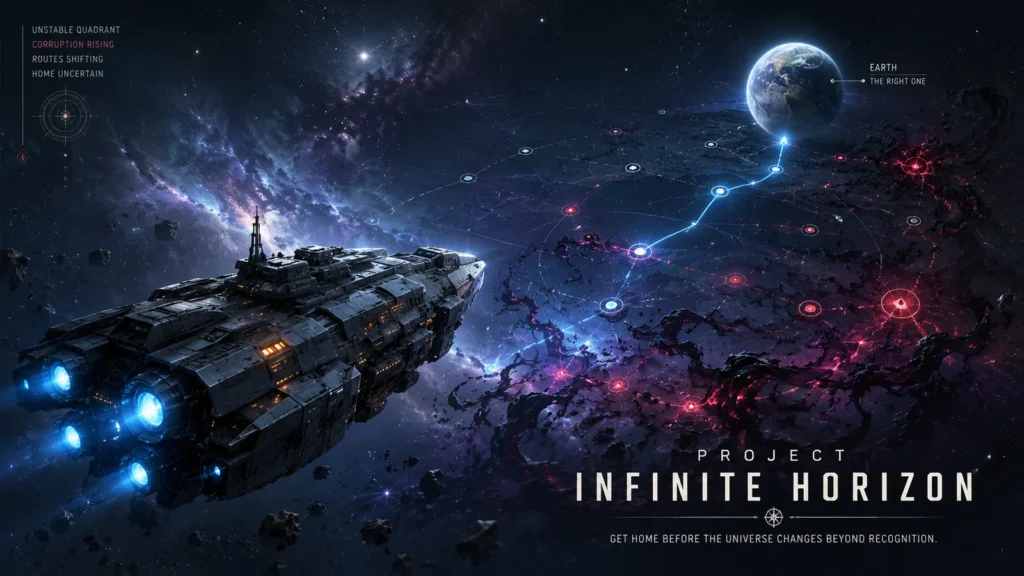
Studio Update Project Infinite Horizons
June 23, 2026
5 min read
Building Games Where You Play Who You Become
Welcome to Character Sheet Studios. We are a small Canadian game studio based in British Columbia, shaped by multinational roots and a lifelong love of tabletop RPGs, strategy

Read Updates